


Natural Stone Cladding Z Panels and Tiles are real stone covering materials for exterior walls, house facades, garden walls, entrances, fireplaces and feature walls. Stone Cladding Z Panels are deeper, heavier and give a more substantial stacked or tiered stone look, while Split Face Tiles are thinner natural stone materials mainly used where a lighter decorative wall finish is wanted.
Stone Cladding Z Panels and Tiles
Our Stone Cladding Z Panels are made from loose pieces of genuine natural stone assembled into larger modular panels. The thicker stone gives stronger projection, shadow and 3D depth. They are used more for exterior stone cladding, garden walls, entrances, larger fireplaces and architectural wall features.
Split Face Tiles use thinner natural stone strips and make a lighter, lower-profile stone wall finish. Both products are real natural stone, but the thickness, construction, weight and finished look are quite different, so they should not be considered as the same type of wall product.
Stone Cladding Z Panels vs Split Face Tiles
Natural stone wall products have many names in the UK market, including stone cladding panels, stone wall panels, Z panels, stacked stone panels, stone veneer panels and split face tiles. Sometimes very different products are sold under similar names. The actual stone thickness, backing, panel weight and intended use are more important than the product name itself.
| Comparison | Stone Cladding Z Panels | Split Face Tiles |
|---|---|---|
| Construction | Thicker pieces of natural stone assembled into substantial modular panels, normally with some form of reinforced backing. | Thinner natural stone strips assembled into lighter decorative wall tiles. |
| Backing | Cement-backed or mesh-backed depending on the panel. | Normally without a heavy cement backing. |
| Typical Depth | Approximately 30–50mm overall stone profile, depending on the stone and natural variation. | Usually around 7–20mm depending on the product. |
| Weight | Heavier and much more substantial. | Thinner, lighter and easier to handle. |
| Appearance | Deeper stone relief, more shadow and a stronger stacked-stone look. | Finer split-stone texture and generally a flatter decorative wall finish. |
| Typical Use | Exterior walls, house facades, garden walls, entrances, fireplaces and architectural features. | Interior feature walls, fireplaces and lighter decorative wall areas. |
For more detail, read our Stone Cladding Z Panels vs Split Face Tiles: What’s the Difference? .
How Stone Cladding Z Panels Are Made
Stone Cladding Z Panels are made from separate pieces of natural stone put together into a larger wall panel. This keeps much of the irregular natural stone look and depth, but installers can work with complete panels instead of fixing every loose stone piece one by one.
Cement-Backed Stone Cladding Z Panels
Our cement-backed Stone Cladding Z Panels have substantial natural stone pieces fixed onto a rigid cementitious backing, with fixing hooks built into the panel construction. They are heavier panels, but the cement backing and hooks make the separate stone pieces work as one complete unit and provide a stronger fixing option for suitable wall installations.
Mesh-Backed Stone Cladding Z Panels
Mesh-backed panels use reinforced mesh and bonding material behind the stone pieces. There is less solid backing material, so they can be lighter than cement-backed panels but still keep the deeper profile of real Stone Cladding Z Panels.
Interlocking Z-Panel Shape
The Z shape is important. The ends are staggered, so neighbouring panels do not meet on one straight vertical line. After the panels are mixed and installed correctly, it becomes much harder to see where one panel finishes and the next panel starts.
Where Stone Cladding Z Panels Are Used
- Exterior Stone Cladding – House facades, extensions, entrance walls and outside architectural features.
- Garden Wall Cladding – Block walls, boundary walls, raised beds and outdoor living areas.
- Stacked Stone Walls – Where a deeper real-stone texture and stronger 3D effect are wanted.
- Entrance Features – Doorways, porches, pillars and front entrance areas.
- Fireplace Cladding – Natural stone around substantial fireplaces where the wall construction and heat conditions are suitable.
- Commercial Stone Cladding – Reception walls, restaurants, hotels, shops and other feature wall projects.
Choosing Stone Cladding Z Panels
First look at the finish you want. Deeper Z Panels make stronger shadow and more stone projection. A thinner tile gives a finer wall surface. After that, panel construction, stone depth, total weight and the wall itself are the things that matter when choosing the product.
Natural stone is not completely uniform. Colour, grain, mineral markings, stone thickness and surface projection can change from piece to piece. For a better finished wall, open several boxes and mix the panels during installation rather than finishing one section from one box only.
Stone Cladding Z Panels Installation
Stone Cladding Z Panels need a stable load-bearing wall, suitable high-performance stone adhesive and good adhesive coverage. Because the panels are thicker and heavier than normal wall tiles, the panel weight, wall background, installation height and exterior exposure all need to be considered.
The Same Stone Can Look Completely Different
Stone Cladding Z Panels and Split Face Tiles can be made from the same natural stone but still look very different on the wall. Oyster Quartz is a good example. Our Z Panels use more of the natural outside quarry face, while Split Face Tiles are made by splitting the stone and showing a newly opened internal face. So even though the stone is Oyster Quartz in both cases, the colour, texture, stone depth and final wall appearance can be very different.
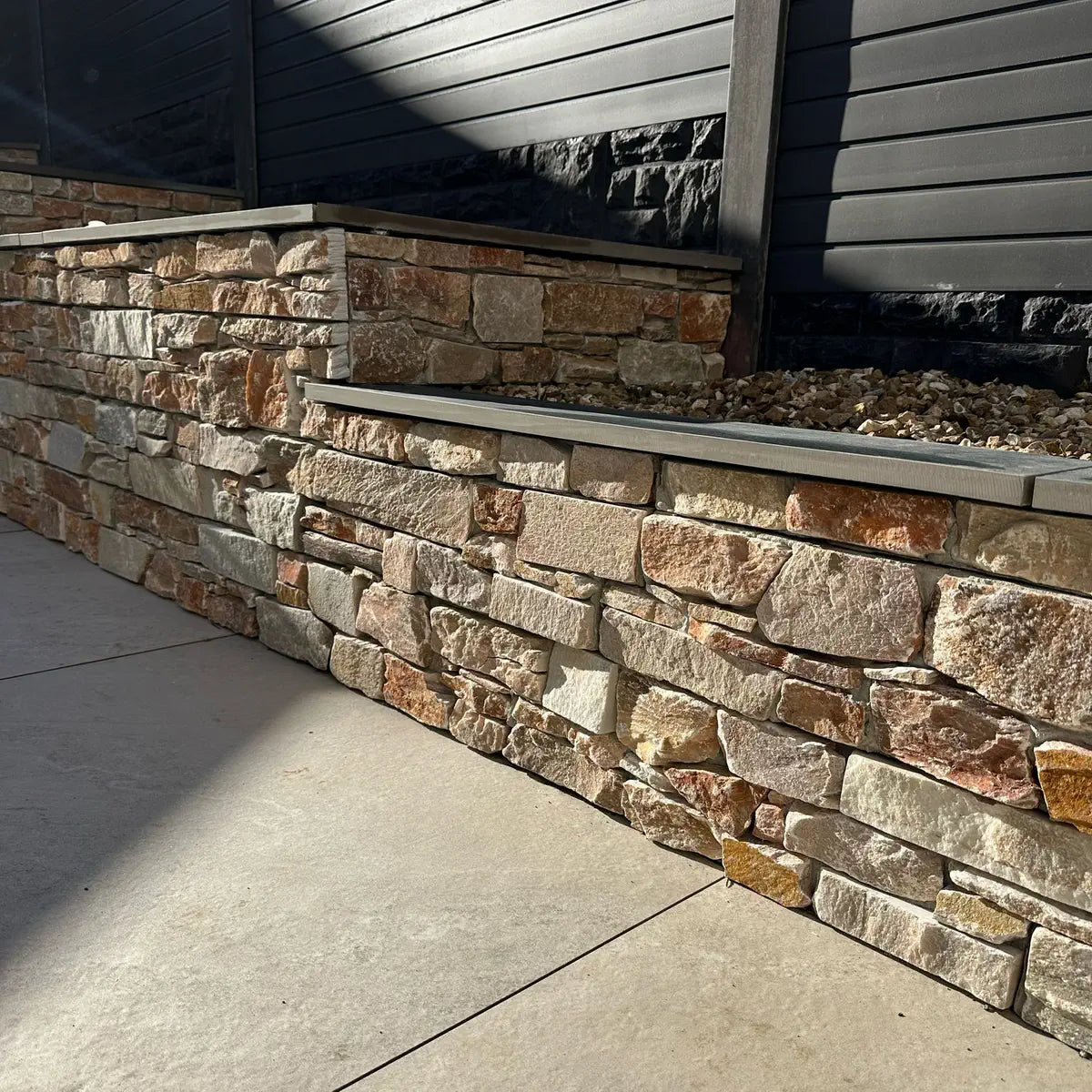

Stone Cladding Z Panels Installation
Stone Cladding Z Panels require a stable, load-bearing wall, a suitable high-performance stone adhesive and full adhesive coverage. Because Z Stone Panels are substantially heavier than standard wall tiles, substrate strength, panel weight, installation height, corners and any required mechanical restraint should be considered when installation.
For additional installation guidance article, see our Stone Cladding Wall and Substrate Guide and also High Performance Adhesives for Stone Cladding.
If you are using natural stone Z cladding panels or tiles for a garden wall, raised bed, outdoor kitchen, entrance or feature wall, you may also need paving slabs for the surrounding patio, paths or seating areas. Explore our Indian sandstone paving, limestone paving, granite paving and porcelain paving slabs, or browse our complete paving slabs collection. For paths, driveway edges, steps and smaller paved areas, natural stone cladding can also be combined with block paving, clay brick pavers, granite setts, sandstone setts, limestone cobbles, or matching coping stones and edging stones and garden stone steps to create a coordinated transition between vertical stonework and ground surfaces.
Stone Cladding Z Panels & Tiles - Frequently Asked Questions
What Is Natural Stone Cladding?
Natural stone cladding is a decorative wall-facing system made from genuine stone rather than a printed or manufactured imitation. It can include substantial Stone Cladding Z Panels, mesh-backed or cement-backed panels, as well as thinner Split Face Tiles. The finished stone surface is non-structural: the wall or supporting substrate behind the cladding must carry the complete installed load.
What Are Stone Cladding Z Panels?
Stone Cladding Z Panels are modular natural stone panels made from individual stone pieces arranged into a larger interlocking unit. Their staggered Z-shaped ends help break up continuous vertical joints so adjoining panels visually blend into one continuous stacked-stone wall. Compared with thinner decorative tiles, Z Panels normally create greater projection, shadow and three-dimensional depth. Read our guide to Natural Stone Cladding Z Panels.
What Is the Difference Between Stone Cladding Z Panels and Split Face Tiles?
Stone Cladding Z Panels are generally thicker, heavier and more structurally substantial, often using deeper individual quarried stone blocks and reinforced panel construction. Split Face Tiles are normally thinner and lighter decorative natural stone tiles made from relatively slim stone strips. Both create genuine stone walls, but they should not be treated as the same product simply.
Is Stone Cladding Suitable for Exterior Walls?
Yes, our natural stone cladding Z panels and tiles can be used on exterior walls when the stone, panel construction, substrate, adhesive, fixing method and weather detailing are appropriate for external exposure. Exterior installations must account for rain, frost, wind, movement, wall tops, openings and drainage rather than relying on the stone face alone. See our Best Stone Cladding for Exterior Walls in the UK.
How Thick Are Natural Stone Cladding Z Panels?
Substantial natural stone Z Panels are commonly around 30–50 mm overall, with many products approximately 40–45 mm depending on the stone pieces, backing and natural surface variation. Split Face Tiles are considerably thinner, typically around 7–20 mm. Always use the dimensions of the exact product when planning wall build-up, corners, reveals and clearances.
How Heavy Is Natural Stone Cladding?
Natural stone cladding can be significantly heavier than conventional porcelain wall tiles. Substantial Z Panels may place a considerable dead load on the wall, particularly where thick stone pieces and cementitious backing are used. The complete installed weight, including stone, backing and fixing materials (hooks), must therefore be considered when selecting the substrate and fixing system.
What Wall Surfaces Can Stone Cladding Be Installed On?
Suitable backgrounds can include sound concrete, stable brickwork or blockwork, correctly specified cement render and approved tile-backer systems. The substrate must be structurally capable of supporting the complete installed load and must be clean, stable and compatible with the fixing system. Standard plasterboard, painted surfaces, insulation boards and timber-based substrates should not automatically be assumed suitable for heavy natural stone panels. Read our Stone Cladding Wall and Substrate Guide.
Can Stone Cladding Be Installed Directly onto Brick or Blockwork?
Potentially yes, provided the brickwork or blockwork is sound, stable, sufficiently flat and capable of supporting the required load. Loose coatings, dust, contamination, weak mortar and significant irregularities must be dealt with before installation. The adhesive and any mechanical fixing system must also be suitable for both the substrate and the particular stone cladding panel.
What Adhesive Should Be Used for Stone Cladding Z Panels?
Use a manufacturer-supported adhesive system specifically suitable for the natural stone, panel backing, substrate, vertical application and interior or exterior environment involved. Heavy stone panels require reliable and substantially complete adhesive contact rather than isolated mortar spots or dot-and-dab fixing. An S1 classification describes adhesive deformability but does not by itself prove that an adhesive is suitable for every heavy stone cladding system. See our Stone Cladding Adhesives.
Does Heavy Stone Cladding Need Mechanical Fixing?
Sometimes. Mechanical restraint depends on the panel weight, backing system, substrate, installation height, exposure, wind loading and consequences of failure. Our cement-backed Stone Cladding Z Panels include mechanical fixing hooks, which can be secured back to the wall with suitable screws or bolts to provide additional restraint. Heavy, high-level, exposed, commercial or public-facing stone cladding should not automatically be assumed safe on adhesive alone, and the fixing method should suit the wall and project conditions.
How Do Z Panels Hide the Joints Between Stone Cladding Panels?
The staggered ends of a Z Panel interlock visually with neighbouring panels, preventing the wall from developing obvious continuous vertical sheet lines. Correct setting out, joint staggering and mixing panels from several boxes are still important. A well-installed wall should read as a continuous natural stone surface rather than a grid of individual factory-made panels.
How Are Stone Cladding Corners Finished?
External corners are finished differently depending on the Z Panel system. Our cement-backed Stone Cladding Z Panels require separate purpose-made corner panels, so corner quantities should be calculated and ordered separately. Our mesh-backed Stone Cladding Z Panels are supplied in mixed boxes, with around one quarter of the panels suitable for forming corners. These panels can be used either as straight panels or assembled around external corners, so separate corner pieces normally do not need to be ordered. Read our Z-Panel Corner Installation Guide.
Is Natural Stone Cladding Waterproof?
No. Natural stone cladding is not the wall's primary waterproof layer, and stone and joints can absorb moisture. However, our exterior natural stone is highly weather-resistant, much like brick or traditional natural stone masonry, and can repeatedly get wet and dry over a typical service life of 40 to 50 years, often much longer when correctly installed. Good drainage, wall detailing and installation are more important than trying to make the stone itself completely waterproof.
Does Exterior Stone Cladding Need Sealing?
Not always. The requirement depends on the stone type, porosity, appearance and exposure. A compatible breathable impregnating sealer can sometimes reduce staining and water uptake, but it may also alter the colour or surface appearance and should be tested first. Sealing is a maintenance treatment, not a substitute for correct exterior wall construction and weather detailing.
How Long Does Natural Stone Cladding Last?
Natural stone itself can remain durable for many decades, but the service life of a cladding installation depends on the complete system rather than the stone alone. Substrate stability, adhesive compatibility, mechanical restraint where required, drainage, movement accommodation, exposure and workmanship all influence long-term performance.
How Much Extra Stone Cladding Should I Order?
For a straightforward rectangular wall, around 10% additional material is commonly practical for cutting, selection and possible breakage. Projects with several corners, returns, window openings, complex detailing or extensive cutting may require around 10–15% or a project-specific allowance. Corner units should be measured separately, and panels from several boxes should be blended during installation.
How Do You Clean and Maintain Natural Stone Cladding?
Remove loose dirt with a soft brush and use clean water or a pH-neutral cleaner suitable for the particular stone when deeper cleaning is required. Avoid brick acid, vinegar and other acidic products on acid-sensitive stones and cementitious materials. Cleaning methods should be tested first, particularly on textured natural stone. Read our Stone Cladding Cleaning and Maintenance Guide.
Stone Cladding Z Panels & Tiles - Knowledge Hub
Benefits of Natural Stone Cladding
Learn about the main advantages of natural stone cladding, including durability, natural colour and texture variation, long-term appearance and its use on both interior and exterior walls. View the Natural Stone Cladding Benefits Guide →
Choosing Stone Cladding Z Panels
Compare Stone Cladding Z Panel systems, including mesh-backed and cement-backed construction, and understand how panel weight, backing, wall type and installation conditions influence product selection. View the Stone Cladding Z Panel Guide →
Stone Cladding Z Panels Installation Guide
Read the practical installation guidance for substantial Stone Cladding Z Panels, including wall preparation, substrate suitability, adhesive coverage, corners, exterior exposure and fixing considerations. View the Stone Cladding Installation Guide →
Split Face Tiles Installation Guide
Split Face Tiles are thinner and lighter than substantial Z Panels and have different installation considerations. This guide covers suitable wall preparation, adhesive application, panel alignment, cutting and corner detailing. View the Split Face Tiles Installation Guide →
Stone Cladding vs Stone Slips
Compare modular Stone Cladding Z Panels with individually installed stone slips, including differences in installation method, wall appearance, panel depth and project suitability. View the Stone Cladding vs Stone Slips Guide →
Stone Cladding Price Per Square Metre
Understand the factors that influence UK stone cladding prices per square metre, including stone type, Z Panel construction, backing system, installation complexity and project scale. View the Stone Cladding Price Guide →
- Choosing a selection results in a full page refresh.